Product
Most AI creative generators start with a text box. Type what you want. Be specific. Add more detail.
For creative directors and art directors, this is exactly why none of these tools lead to consistently valuable output. The input model is broken.
You already know what you want. You have references: film stills, editorial photography, past campaign imagery, location scouts, lifestyle shots. Images that capture a mood, a composition, a tonal quality. The problem isn't that you can't articulate the vision. It's that the tool is asking you to describe it in words instead of showing it.
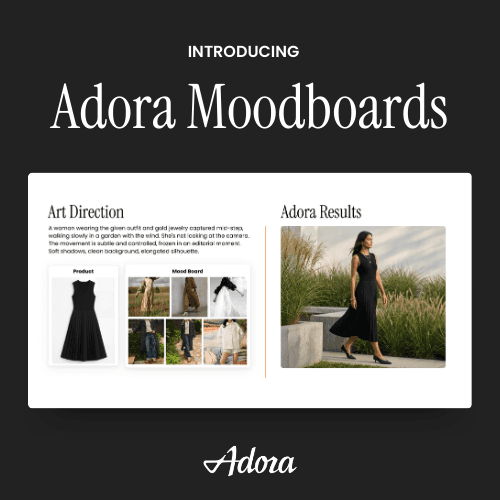
Today, we're introducing moodboards in Adora's creative generation workflow. Instead of translating your creative vision into text prompts, you can now upload visual references like film stills, editorial photography, past campaigns, lifestyle imagery…you name it, and use them to direct what Adora generates. It's a fundamental shift in how creative teams interact with AI-powered generation, built on a simple belief: the best creative tools should work the way creative teams already think.
The translation tax: why creative direction gets lost in most AI workflows
Every creative team already has a language for setting visual direction: moodboards. They align stakeholders, anchor campaigns, and communicate intent faster than any brief ever could. Lighting, composition, color palette, texture, spatial relationships, atmosphere, styling: a single moodboard can convey all of it without a word written.
But in most AI generation workflows, that language doesn't exist. You get a text box. Maybe some parameter sliders. So your team reverse-engineers prompts from something they already expressed visually, and the nuance dies in translation.
The more layered the vision, the worse it gets. Imagine you want the compositional framing from an editorial spread, the natural lighting from a film reference, the product styling from a past campaign, and the energy of a lifestyle shoot, all combined in one output. Try writing that prompt. Then try it again when the first three attempts miss the mark.
It's like describing a song to a musician instead of just playing them the reference track. The information is there. The translation is the problem.
When it takes longer to get useful output from an AI tool than to do the work without it, creative teams stop using it. That's the real adoption problem.
Moodboard, meet creative generation
We built moodboards directly into Adora's creative generation workflow because we believe creative teams shouldn't have to change how they think in order to work with AI.
Upload your references (editorial photography, film stills, past campaign imagery, lifestyle shoots, product photography, location references) and Adora uses those visual signals to inform what it generates. The direction you'd normally spend ten minutes trying to articulate in a prompt, expressed the way you already express it: visually.
And what a moodboard can communicate is far broader and more precise than any text prompt:
Lighting and shadow treatment
Camera angles and subject placement
Color grading and tonal quality
Compositional framing and spatial relationships
Environmental context and setting
Styling and wardrobe direction
Texture and material quality
Energy and mood of the scene
Seasonal or cultural aesthetic
Format-specific visual language (e.g, editorial vs. social vs. catalog)
The list goes on
Moodboards get even more powerful when you start combining elements across references.
Want a model from one image, products from three separate shots, a background from another, and a tonal quality from a sixth? Upload them all. Adora reads the visual signals across the board and composes outputs that bring those elements together, the way a creative brief would, but without the translation step.
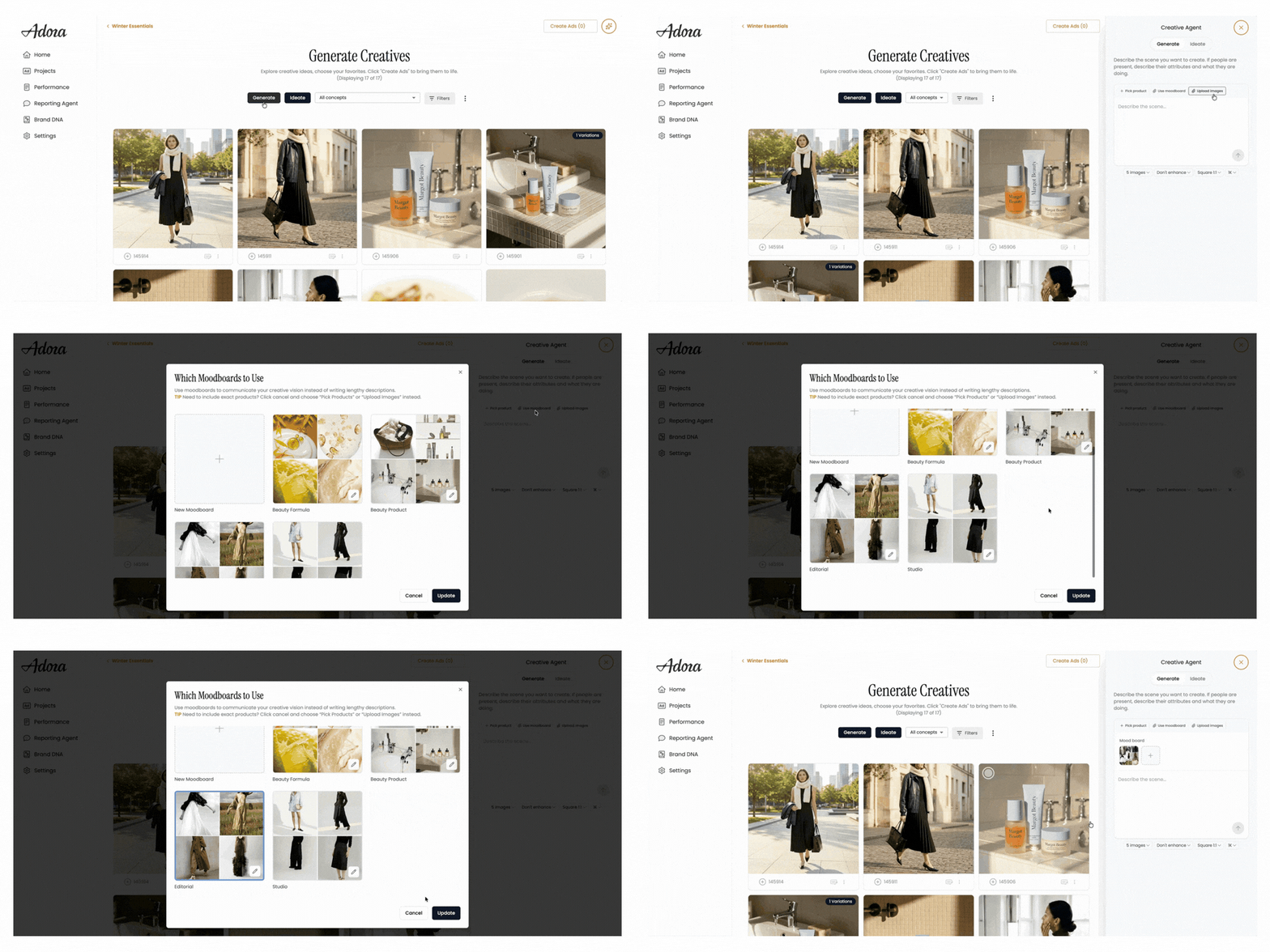
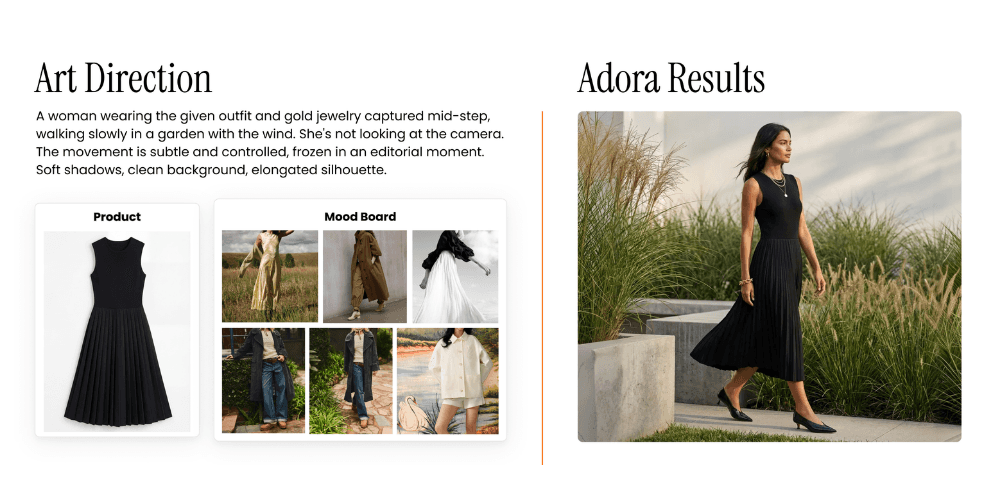
A few examples of how this works in practice:
An art director preparing a holiday campaign uploads warm, candlelit lifestyle references alongside product shots and editorial images that capture the intimacy they want the campaign to carry. That direction holds across every generation within the campaign.
A production designer working on a spring launch brings in bright, outdoor editorial references, natural-light photography, and specific SKU images. The outputs immediately reflect that direction; no prompt iteration needed.
A senior creative exploring a new concept combines film stills for mood, architectural photography for composition, and past campaign assets to anchor the brand's existing visual language as they push into new territory.
In each case, the moodboard lets you focus on the scene you're trying to create instead of struggling to describe the style in words. You still direct the vision. The moodboard just makes that direction count.
Why this works differently in Adora
You could upload reference images to any AI tool. But that still leaves you doing most of the heavy lifting: establishing your brand's identity, getting your products to render accurately, and trying to engineer the right combination of inputs to produce something you'd actually put in market.
Adora is different because the moodboard is one layer in an environment already built around your brand.
Your Brand DNA is already trained. Every generation starts from a foundation of your brand's visual identity, guidelines, and creative standards. You don't re-establish that for every campaign. It underlies all of them.
Your products are already uploaded into the platform. Products appear as they actually look, with accurate details and proportions, without you needing to prompt for faithful representation of your own catalog.
So the moodboard does what it should do: set creative direction. Not compensate for a tool that doesn't know your brand. Not engineer prompts to get your products to look right. Just direction: the thing your creative team actually wants to do.
This is the difference between prompting and art direction. The moodboard sets the campaign-level vision. Brand DNA ensures every output is on-brand. The product catalog ensures it's authentic. Your team stays focused on the storytelling: visualizing the scene, crafting the narrative, shaping the feeling. Not on wrestling with the tool.
And because moodboards operate at the campaign level, a creative director can set the visual direction once and the entire team works within it. No repeated briefings, no style drift across assets, no wondering if everyone is referencing the same source material.
Built for what comes next
Moodboard-driven generation is the starting point, not the end. Once your team has creative they're aligned on, Adora is built to take it forward: finalizing ads with templates, getting them into market across platforms, and surfacing insights on what's actually performing. The creative direction you set in the moodboard carries through to the ads your customers see.
The question for creative leaders evaluating any AI tool shouldn't just be "can this generate good output?" It should be "does this tool work the way my team already works?"
Moodboards aren't new. They're foundational to the creative process. We built them into our creative generation flow because AI shouldn’t require your team to learn a language that prioritizes “efficiency” over creativity, consistency, and control. It should truly expand your team’s capabilities and align with the ways they work best.
When the workflow matches how your team naturally communicates, the work gets better. And when it flows through an environment that already knows your brand, your products, and the channels you’re designing it for, the work gets used.
See how moodboard-driven generation brings your creative vision to life, with your brand, your products, and your team in control.
Request early access to Adora.