Thought Leadership
Most AI marketing tool promises sound all too familiar to enterprise marketers. Transform your marketing. Accelerate time-to-market. Generate unlimited creative. Optimize every campaign automatically. Your inbox overflows with vendors claiming their platform will finally change everything.
And yet, the numbers paint a very different picture. By now, most of us have read the infamous MIT report stating that 95% of enterprise AI pilots fail to reach production. And while more recent reports from McKinsey and Wharton point to slightly rosier pictures, the takeaway from all three is clear: if 2025 was another year of AI experimentation, 2026 desperately needs to be the year of actual impact.
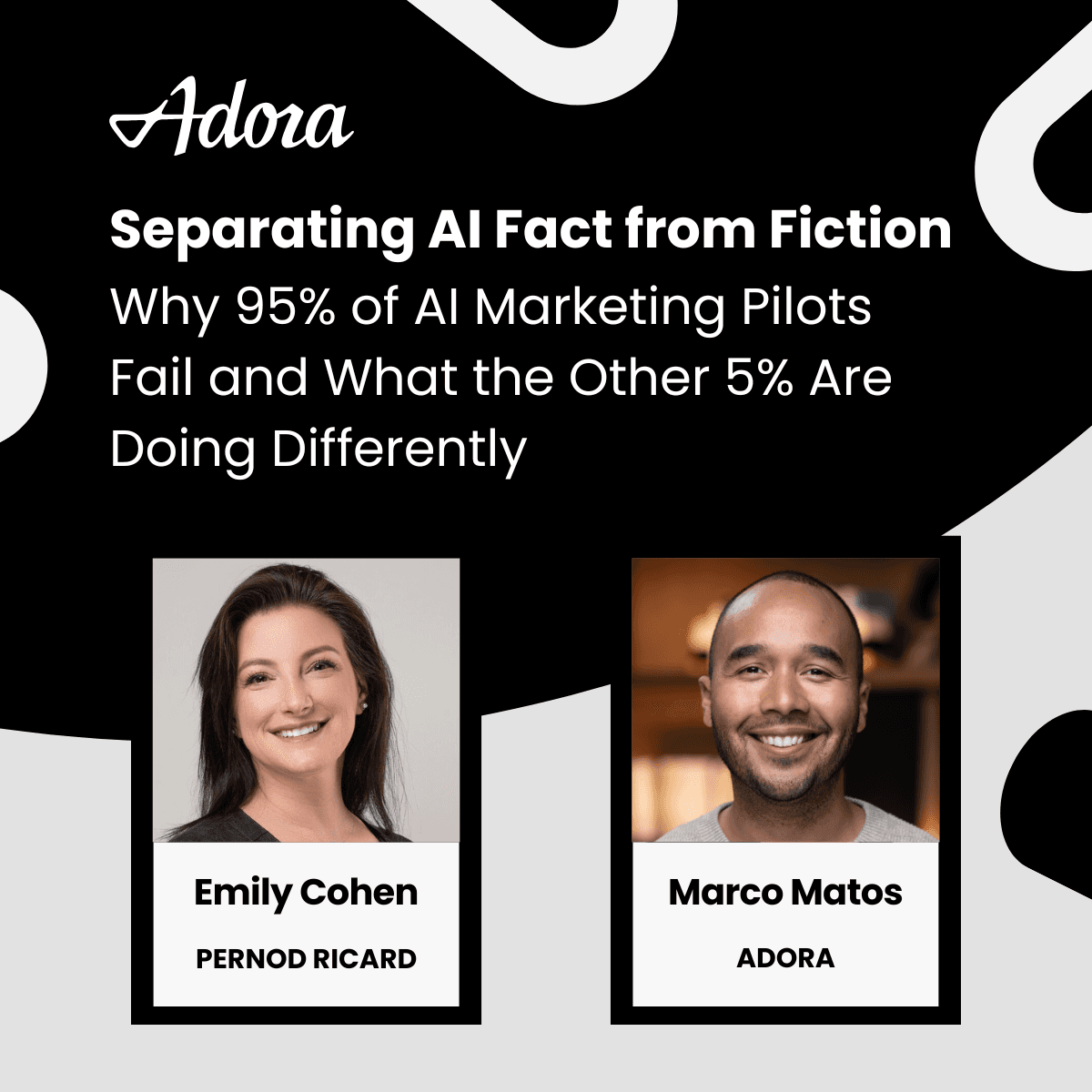
Emily Cohen has been through this before.
From consulting at Bain & Company to managing brands at Revlon and LVMH to leading marketing teams across industries to teaching sales and marketing strategy at Columbia and Wharton, she’s seen several technology hype cycles play out.
As Head of Global Innovation for billion-dollar spirits brands including Jameson and Absolut at Pernod Ricard, Emily has a front-row seat to what's working in AI-driven marketing and what's still noise.
That's why we invited Emily to join our CEO Marco Matos for a candid conversation last month about moving from testing AI to achieving real impact.
Their discussion covered not just why 95% of AI marketing pilots fail, but what the other 5% are doing differently.
Here are the most critical insights for marketing leaders refining their 2026 strategy.
The Real Reasons 95% of AI Pilots Fail
Emily was direct about why so many AI initiatives stall: "Often there are so many things going on in an organization that must be done that the potential of the thing we're testing doesn't always get the kind of focus and attention it might need."
Case in point: according to the MIT study, only 5% of custom enterprise AI tools reach production, even as 80% of organizations investigate them. McKinsey's research also found that even when AI adoption is high, transformation remains rare.
The result? Billions of dollars in resources dumped into AI pilots that never scaled while competitors who successfully adopted AI pull further ahead.
While there is no shortage of AI tools that overpromise and undeliver, the problem often isn’t the technology. It's how organizations approach implementation.
Emily identified four specific failure patterns she's seeing across the industry.
1. Unrealistic Expectations About What AI Can Deliver
"I think sometimes we expect AI to just give us the answers," Emily said. "It takes me back to the days of early internet video, when my boss came to me and said, 'We need to create a viral video.' And as marketers, we've all been there, and that's just not how you go there."
Expecting AI to automatically generate breakthrough creative or magically optimize campaigns without human judgment sets projects up for disappointment.
"We need to set our expectations appropriately and understand how it's going to feed into our process," Emily explained.
2. Insufficient Resource Allocation
Even when pilots get funded, they rarely get the sustained attention required to succeed.
"The second is really the time, resources, and internal support needed to be able to truly give [the AI pilot] the kind of focus it needs to carry forward to that next step," Emily noted.
Marketing organizations are stretched thin. Adding an AI pilot without adjusting other priorities means something gets sacrificed. When you’re hyperfocused on this quarter’s revenue, it’s hard to invest in initiatives designed to unlock future value.
3. No Time Built in to Actually Learn
"Often, I find we do a test and then we haven't really thought about that next step," Emily observed. "We get together to do a debrief and say, 'Yeah, I think that's interesting,' but we don't necessarily always have the time to really focus, debrief, and understand how this test can be applied."
Wharton research found that enterprises that succeeded in AI adoption moved from pilot to implementation in 90 days. Those that failed took nine months or longer, treating pilots as one-off experiments rather than structured learning.
Without dedicated time to analyze results, extract insights, and apply learnings to the next iteration, pilots become expensive science projects that never scale.
4. Chasing Hype Instead of Solving Business Problems
"Everyone is trying to jump on the bandwagon," Emily said. "Every tool that comes across my desk these days has an AI component, and the trick is really understanding what I need and how to keep my world contained so that I can see progress, because otherwise we're all over the place."
Organizations are piloting AI marketing tools for many reasons: competitive pressures, persistent vendor outreach, board pressure, etc. But without a clear business problem to solve, these AI pilots lack the focus required to drive meaningful value.
And it’s not just the over-eager brands and agencies that are to blame for all of the hype.
"Some of my vendors are trying to get out of the gate so quickly that the promise is exceeding the reality right now," Emily noted. "That's fine. We're early days. But as a busy marketer, you can't do everything. You really need to focus where you can."
What Separates the 5% That Succeed
Successful implementations demand that you:
Start with a specific business problem
Allocate real resources
Build in structured learning, and
Resist the pressure to test everything.
"You want to test, you want to be aware, you want to play around," Emily said, "but you need to be able to manage that pipeline, that developmental flow, so that you're not all over the place, and you can show forward momentum and real results and KPIs that help lead to that next project."
That discipline, knowing what to ignore, might be more important than knowing what to test.
Start with the Right Target
"I can't tell you what to test until I understand what's important to you, what's your biggest problem right now, what's your biggest challenge to your goals right now," Emily said. "Once I know that, then we can focus on what to test."
The AI era challenge most enterprise marketers face isn’t how to find the most advanced AI capability. It's how to conduct an honest assessment of where bottlenecks are consistently slowing your execution or where manual processes prevent testing and scaling at the pace your market demands.
Emily’s team uses AI extensively for research synthesis and ideation because synthesizing marketplace information has been a genuine bottleneck.
"For something like ideation, AI is a huge help for pulling together trends, looking at competitors' activities, understanding what is out there for information in the marketplace, and pulling that into our sphere of vision," Emily explained. "That's an incredible time saver, and it's really helpful at analyzing and pulling all of that data."
Different organizations have different bottlenecks. What works for Pernod Ricard might not address your specific constraints.
Human-in-the-Loop Is the Sustainable Competitive Advantage of the AI Era
The headcount pressure is obviously real: the Wharton research shows that VP+ leaders expect 18% net fewer hires for entry-level roles and 10% fewer for mid-level positions as a result of AI.
But when it comes to senior marketers, most leaders, including Emily, agree that replacement isn’t the chief concern.
"I don't think AI is in danger of replacing us just yet," Emily said. "I believe absolutely in that mix of human irrationality. The other day in a seminar I attended, someone said 'AI is not creative. It's the human that brings the creativity to it.'"
The real question is, “How do I provide my team with the tools they need be successful as we’re being asked to grow output without growing headcount?”
"AI is a productivity tool. And who is it making more productive? Your good, solid, experienced performers," Emily explained.
So maintaining your market team’s competitive advantage in the AI era requires effective human oversight. It also demands that you understand what specifically humans contribute that AI can't replicate.
Brand Authenticity Can't Be Generated
"We all know the content we see online where someone's gone into an AI engine and it's spit out seven versions of the same short blog post, and they've got one for LinkedIn and one for Reddit and one for something else, and it doesn't sound like them, because it all sounds the same," Emily observed.
The problem isn't unique to AI. Recommendation engines and social algorithms have been pushing brands toward homogenization for years. AI has just accelerated this trend.
"As our trends and the recommendation engines tend to center more-and-more on the most common results, we're training them towards that common line," Emily said. "And what I'm looking for authentically from the brand is something that's not as common. It's unique to my brand."
For enterprise brands managing portfolios worth billions, the loss of distinctiveness represents existential risk. When every brand uses the same AI tools trained on the same data, differentiation disappears.
"Authenticity in my brands is that individuality and distinctiveness that makes that brand, that brand. All of my brands have a personality. All of them have an identity. I can't lose that in the combination of just trusting AI for the product."
The 80-20 Rule of AI
Emily introduced a framework that crystallizes where AI delivers value versus where humans remain essential.
"For something like ideation, AI is a huge help," Emily explained. "I can probably get 80% of the ideas that I'll get in a full day of ideation in 20 minutes from an AI engine."
"That said, that doesn't mean I'm done there, right? Because it's the next 20% and the recombination of those 80% that's going to help us get that last mile, and going to help really create the distinction for my team and my brands in the marketplace."
The 80% provides the foundation. The research. The competitive scan. The trending topics. But without the 20%, you're working from the same inputs as every competitor.
"I've got the same information in the same market and dynamic as everyone else, and we're all working from the same tool. So the thing that really makes the difference is the way we recombine it and that element that we can add in that last moment."
This applies beyond ideation.
"Let's put uncanny valley and six fingers on a hand and all of those mistakes aside. AI will create something that is almost perfect based on design principles," Emily said. "Its design principles are still going to be coming out of theory, so perfect theory. Whereas our eyes and our emotions are not triggered by perfection, they're actually driven by that imperfection."
Human response to creative isn't rational. It's shaped by lived experiences, cultural context, and emotional associations that no data set accurately captures today.
"AI can give me 10 different packages to look at, but my team and I need to go in and determine which ones work for the brand. Which ones work in this context best? There is a judgment there, and I can test the perfect AI model next to the one we've picked. And you know, you can test to get any result you want, but the one that will truly succeed is the one that touches people."
Generative AI is providing marketing teams with such a massive opportunity to evaluate new ideas, better understand why certain creative works better than others, scale existing campaigns beyond what you’re reasonably able to create in a shoot, and ensure that the ads you’re running are personalized to every customer and the channel they’re viewing them on. But what it can’t do is replace the taste that arises when good judgment meets human irrationality.
Choosing Technology Partners Who Don’t Pretend to Know Everything about AI
Emily's final piece of advice focused on something most marketing leaders overlook when evaluating AI vendors: intellectual humility.
"I want partners who are not overpromising, but who are being honest about the possibilities and how we're going to get there together," Emily said. "I want them to truly walk me through what we're going to get out of this so that we can go down that road together."
The AI marketing vendor landscape is crowded with platforms promising transformation, disruption, and competitive advantage. Few discuss implementation challenges, learning curves, or organizational change requirements.
"Working with me on a very real level is going to get us to that next step. But I need to understand what we can truly get out of your tool and what we need to put in to get that out."
The distinction Emily draws is crucial: she's not looking for vendors selling finished products. She's looking for partners willing to co-develop solutions aligned with her specific business problems.
"Let's create a roadmap. This is not a one-month thing…What do we do now? What does that teach us? What's happening in the future?’"
Emily's filter for separating real partners from vendors selling hype?
"None of them can keep up with everything that's happening. The ones who admit it to me are the ones I trust more."
Intellectual honesty about capabilities separates transformative partnerships from expensive disappointments. The right partners help you focus. They understand your business well enough to say no to features that don't serve your objectives. They're building for where you're going, not just overselling what they built.
The Key to Successful Marketing AI Adoption in 2026: Focus, Discipline, and the Courage to Say No
Emily's closing thoughts returned to where the conversation began: the overwhelming pressure marketing leaders face trying to navigate AI in 2026.
"By the way, all of your peers are feeling this same overwhelm," Emily said. "There's just way too much going on right now to keep track of, to try to test it all."
Everyone managing enterprise marketing at scale is facing the same challenges: too many tools, too many promises, not enough clarity about what actually works. The marketing organizations pulling ahead in the “AI race” are succeeding not simply because of what they’re doing, but because they’ve gotten really good at saying no.
"Saying no is the biggest opportunity and the biggest challenge in anyone's life, but especially in marketing, we’re used to this," Emily emphasized. "There are tons of opportunities that come at us to partner, to promote our brand, to get involved in the every day. But you have to filter them by what's actually going to drive your brand plan, deliver your bottom line, help you get more customers…improve your reach, and drive folks through that journey and funnel in the right way.
The Framework for Implementing Marketing AI in 2026
Emily distilled her approach to separating AI fact from fiction into something actionable for marketing leaders in the final stages of 2026 planning:
Start with your biggest business challenge right now. Look at your last five marketing reviews or stakeholder meetings. What problem came up in at least three of them? That's your signal. Not the most interesting AI use case. Not what competitors are doing. The problems your organization keeps tripping over.
Build a manageable pipeline for testing and learning. Pick no more than 3 initiatives tied directly to your business goals and give them the resources to succeed or fail properly.
Show forward momentum with measurable KPIs. Don’t buy a hammer that’s searching for a nail. Each initiative needs success criteria defined upfront. If you land on a metric, mean it, and ensure that metric is meaningful to your organization.
If you’re going to say yes, you need to say no. Many vendors are skilled at sustaining conversations long after you’ve decided that their solution isn’t the right fit for your team. While you have to make the time to explore new solutions, you also need to be aware of time spent in discussions that aren’t productive to your team. The discipline to say no might be more valuable than any AI tool you deploy.
In the words of Emily, "Once you know where you're focusing, the answers all start to lay themselves out.”
What Success Looks Like
Success in 2026 won’t require knowing everything about AI. It will require knowing your business problems, allocating real resources to solve them, maintaining human judgment in the loop, and having the discipline to say no to everything else.
Emily's managing billion-dollar brands with this approach. You can too.
The question isn't whether to adopt AI in your marketing organization. That decision has already been made by market forces, competitive pressure, and organizational expectations. The question is how to adopt AI in ways that deliver genuine value, not expensive disappointments.
For marketing leaders willing to start with business problems rather than technology capabilities, focus ruthlessly on a manageable set of initiatives, and maintain the human judgment that creates competitive advantage, 2026 represents real opportunity.
Just don't expect it to be easy. As Emily made clear throughout the conversation, this requires focus, discipline, and the courage to ignore most of what lands in your inbox.
Watch the full conversation between Marco and Emily: